Beef Are the Leading Source of Methane Production
On this folio:
- Overview
- Electricity
- Transportation
- Industry
- Commercial/Residential
- Agriculture
- Land Use/Forestry
Overview
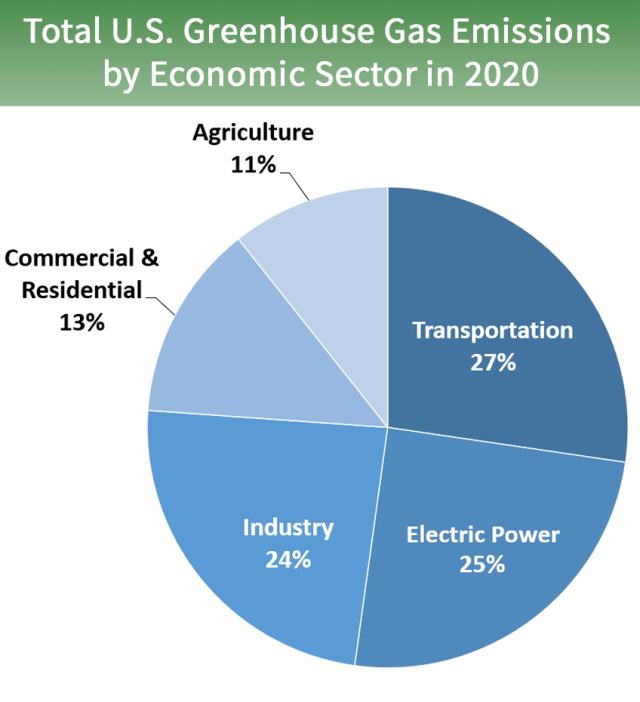
* Land Use, Land-Utilise Modify, and Forestry in the United States is a cyberspace sink and removes approximately 13% of these greenhouse gas emissions. This net sink is non shown in the above diagram. All emission estimates from the Inventory of U.Southward. Greenhouse Gas Emissions and Sinks: 1990–2020.
Larger prototype to salvage or print
Greenhouse gases trap estrus and make the planet warmer. Man activities are responsible for near all of the increase in greenhouse gases in the temper over the last 150 years.i The largest source of greenhouse gas emissions from human activities in the United States is from called-for fossil fuels for electricity, estrus, and transportation.
EPA tracks total U.S. emissions past publishing the Inventory of U.Southward. Greenhouse Gas Emissions and Sinks. This annual report estimates the total national greenhouse gas emissions and removals associated with human activities beyond the United States.
The primary sources of greenhouse gas emissions in the U.s.a. are:
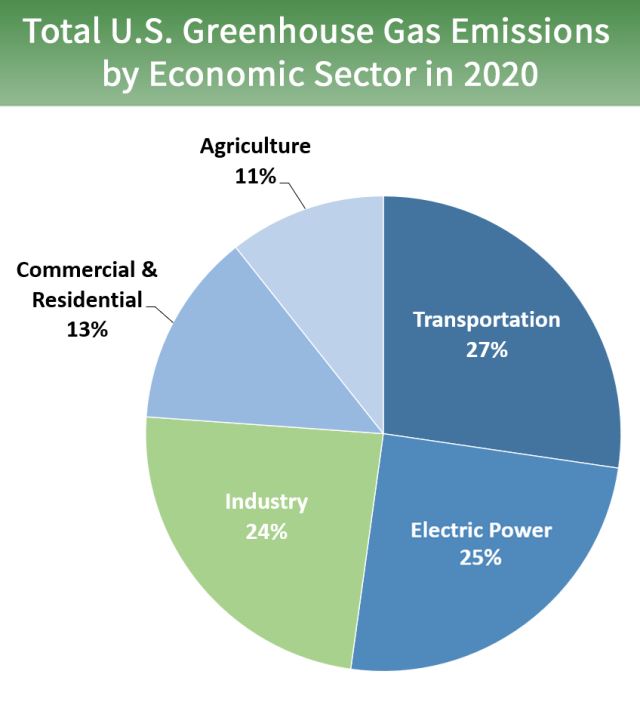
- (27% of 2020 greenhouse gas emissions) – The transportation sector generates the largest share of greenhouse gas emissions. Greenhouse gas emissions from transportation primarily come up from called-for fossil fuel for our cars, trucks, ships, trains, and planes. Over xc% of the fuel used for transportation is petroleum based, which includes primarily gasoline and diesel.two
- (25% of 2020 greenhouse gas emissions) – Electricity product generates the 2d largest share of greenhouse gas emissions. Approximately 60% of our electricity comes from burning fossil fuels, mostly coal and natural gas.3
- (24% of 2020 greenhouse gas emissions) – Greenhouse gas emissions from industry primarily come from called-for fossil fuels for energy, as well equally greenhouse gas emissions from certain chemic reactions necessary to produce appurtenances from raw materials.
- (xiii% of 2020 greenhouse gas emissions) – Greenhouse gas emissions from businesses and homes arise primarily from fossil fuels burned for heat, the use of certain products that comprise greenhouse gases, and the handling of waste.
- (11% of 2020 greenhouse gas emissions) – Greenhouse gas emissions from agriculture come from livestock such as cows, agricultural soils, and rice production.
- (13% of 2020 greenhouse gas emissions) – Land areas tin act as a sink (arresting COtwo from the temper) or a source of greenhouse gas emissions. In the United States, since 1990, managed forests and other lands are a internet sink, i.e., they have absorbed more CO2 from the atmosphere than they emit.
Emissions and Trends
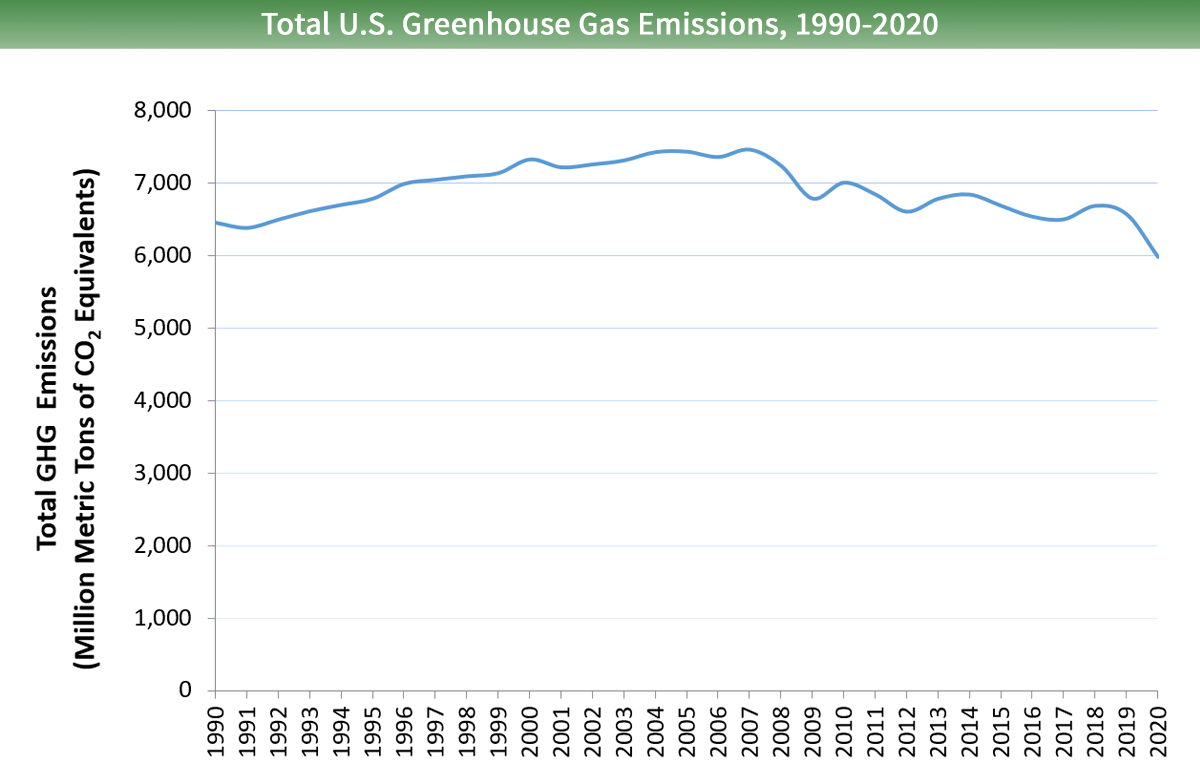
Since 1990, gross U.Southward. greenhouse gas emissions take decreased past vii%. From year to year, emissions can rise and fall due to changes in the economy, the toll of fuel, and other factors. In 2020, U.S. greenhouse gas emissions decreased xi% compared to 2019 levels. The sharp decline in emissions was primarily from CO2 emissions from fossil fuel combustion and was largely due to the coronavirus (COVID-19) pandemic-related reductions in travel and economic activity, including a xiii% decrease in transportation emissions driven by less travel due to the COVID-nineteen pandemic. Electrical ability sector emissions decreased 10% due to a slight decrease in electricity need from the COVID-nineteen pandemic and a continued shift from coal to less carbon-intensive natural gas and renewables.
Larger paradigm to save or impress
References
- IPCC (2007). Summary for Policymakers. In: Climate Change 2007: The Physical Scientific discipline Basis. Contribution of Working Group I to the Fourth Assessment Written report of the Intergovernmental Panel on Climatic change [Solomon, S., D. Qin, One thousand. Manning, Z. Chen, M. Marquis, Yard.B. Averyt, One thousand. Tignor and H.L. Miller (eds.)]. Cambridge University Printing, Cambridge, Uk and New York, NY, USA.
- IPCC (2007). Climate change 2007: Mitigation. (PDF)(863 pp, 24MB) Contribution of Working Group III to the 4th Assessment Report of the Intergovernmental Panel on Climate change [B. Metz, O.R. Davidson, P.R. Bosch, R. Dave, L.A. Meyer (eds)], Cambridge University Printing, Cambridge, Great britain and New York, NY, USA.
- U.S. Energy Information Administration (2019). Electricity Explained - Basics
Electricity Sector Emissions
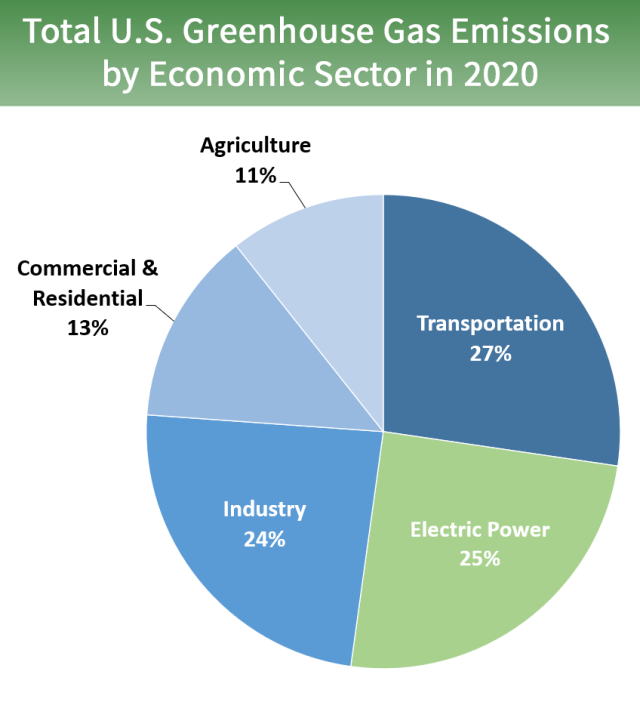
* Land Use, Country-Use Modify, and Forestry in the United States is a net sink and removes approximately 13% of these greenhouse gas emissions. This net sink is not shown in the above diagram. All emission estimates from the Inventory of U.S. Greenhouse Gas Emissions and Sinks: 1990–2020.
Larger paradigm to save or print
The Electricity sector involves the generation, transmission, and distribution of electricity. Carbon dioxide (COtwo) makes upwards the vast majority of greenhouse gas emissions from the sector, but smaller amounts of methyl hydride (CH4) and nitrous oxide (Due north2O) are also emitted. These gases are released during the combustion of fossil fuels, such as coal, oil, and natural gas, to produce electricity. Less than ane% of greenhouse gas emissions from the sector come up from sulfur hexafluoride (SFhalf dozen), an insulating chemical used in electricity transmission and distribution equipment.
Greenhouse Gas Emissions in the Electricity Sector by Fuel Source
Coal combustion is more than carbon-intensive than burning natural gas or petroleum for electricity. Although coal use accounted for near 54% of CO2 emissions from the sector, it represented only xx% of the electricity generated in the United States in 2020. Natural gas use deemed for 39% of electricity generation in 2020, and petroleum utilize deemed for less than 1%. The remaining generation in 2020 came from non-fossil fuel sources, including nuclear (21%) and renewable free energy sources (20%), which include hydroelectricity, biomass, wind, and solar.ane Most of these not-fossil sources, such as nuclear, hydroelectric, wind, and solar, are non-emitting.
Emissions and Trends
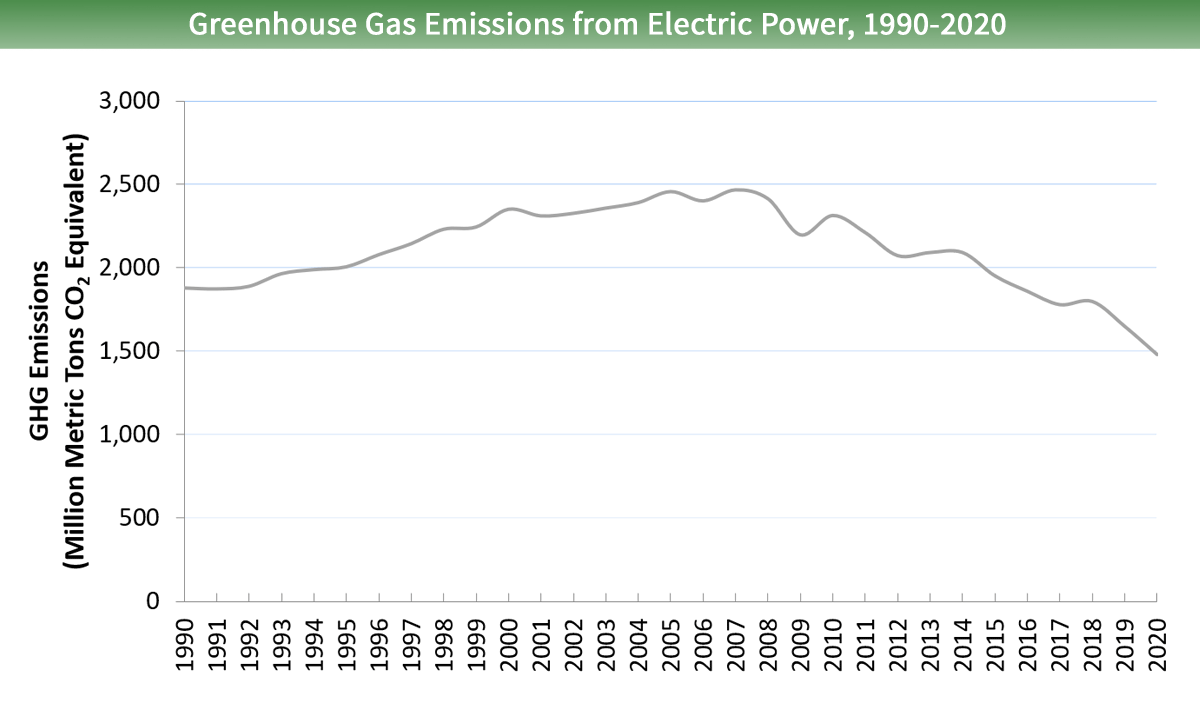
In 2020, the electricity sector was the 2nd largest source of U.S. greenhouse gas emissions, bookkeeping for 25% of the U.Southward. total. Electrical power sector emissions decreased 10% from 2019 due to a slight decrease in electricity demand from the COVID-19 pandemic and a connected shift from coal to less carbon-intensive natural gas and renewables. Greenhouse gas emissions from electricity take decreased past virtually 21% since 1990 due to a shift in generation to lower- and non-emitting sources of electricity generation and an increase in end-employ energy efficiency.
Larger image to save or print
Greenhouse Gas Emissions by Electricity End-Use
Larger epitome to salvage or impress
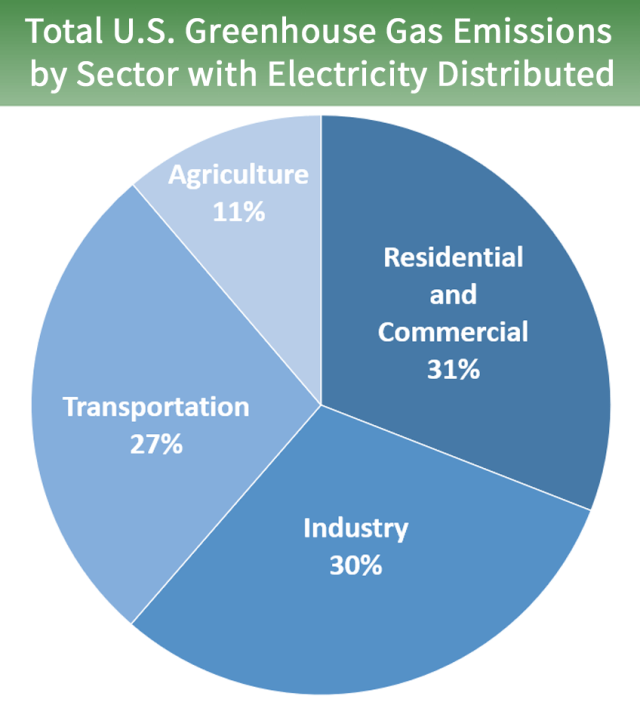
Electricity is used by other sectors—in homes, businesses, and factories, the greenhouse gas emissions from electricity generation tin exist attributed to the sectors that employ the electricity. Looking at greenhouse gas emissions past cease-employ sector can assistance us understand energy demand across sectors and changes in energy use over time.
When emissions from electricity generation are allocated to the industrial end-apply sector, industrial activities account for a much larger share of U.S. greenhouse gas emissions. Greenhouse gas emissions from commercial and residential buildings also increase substantially when emissions from electricity end-employ are included, due to the relatively large share of electricity use (eastward.g., heating, ventilation, and air workout; lighting; and appliances) in these sectors. The transportation sector currently has a relatively low percentage of electricity use, simply it is growing due to the use of electric and plug-in vehicles.
Reducing Emissions from Electricity
There are a variety of opportunities to reduce greenhouse gas emissions associated with electricity generation, transmission, and distribution. The table below categorizes these opportunities and provides examples. For a more comprehensive list, see Chapter 7 (PDF)(88 pp, three.6MB) of the Contribution of Working Grouping III to the Fifth Cess Report of the Intergovernmental Panel on Climate Change.ii
| Blazon | How Emissions Are Reduced | Examples |
|---|---|---|
| Increased Efficiency of Fossil-fired Power Plants and Fuel Switching | Increasing the efficiency of existing fossil fuel-fired ability plants by using advanced technologies, substituting less carbon-intensive fuels, and shifting generation from higher-emitting to lower-emitting ability plants. |
|
| Renewable Free energy | Using renewable energy sources rather than fossil fuel to generate electricity. | Increasing the share of total electricity generated from wind, solar, hydro, and geothermal sources, as well as certain biofuel sources, through the improver of new renewable energy generating capacity. |
| Increased End-Use Energy Efficiency | Reducing electricity utilise and acme demand by increasing energy efficiency and conservation in homes, businesses, and industry. | EPA'due south Free energy STAR® partners avoided over 330 meg metric tons of greenhouse gases in 2019 solitary, helped Americans salvage over $39 billion in energy costs, and reduced electricity use by 500 billion kWh. |
| Nuclear Energy | Generating electricity from nuclear energy rather than the combustion of fossil fuels. | Extending the life of existing nuclear plants and edifice new nuclear generating chapters. |
| Carbon Capture and Sequestration (CCS) | Capturing COii equally a byproduct of fossil fuel combustion before it enters the atmosphere, transporting the CO2, injecting the CO2 deep underground at a carefully selected and suitable subsurface geologic formation where it is securely stored. | Capturing COtwo from the stacks of a coal-fired power found and then transferring the COii via pipeline, injecting the COtwo deep hush-hush at a carefully selected and suitable nearby abased oil field where it is securely stored. Learn more most CCS. |
References
- U.S. Energy Data Administration (2019). Electricity Explained - Nuts.
- IPCC (2014). Climate change 2014: Mitigation of Climate Modify (PDF) (1454 pp, 50MB). Contribution of Working Grouping III to the 5th Assessment Report of the Intergovernmental Panel on Climatic change [Edenhofer, O., R. Pichs-Madruga, Y. Sokona, E. Farahani, S. Kadner, K. Seyboth, A. Adler, I. Baum, Southward. Brunner, P. Eickemeier, B. Kriemann, J. Savolainen, S. Schlömer, C. von Stechow, T. Zwickel and J.C. Minx (eds.)]. Cambridge University Press, Cambridge, Uk and New York, NY, USA.
Transportation Sector Emissions

* State Utilize, Country-Use Change, and Forestry in the United States is a internet sink and removes approximately 13% of these greenhouse gas emissions. This net sink is not shown in the above diagram. All emission estimates from the Inventory of U.Due south. Greenhouse Gas Emissions and Sinks: 1990–2020.
Larger image to salvage or print
The Transportation sector includes the movement of people and goods past cars, trucks, trains, ships, airplanes, and other vehicles. The majority of greenhouse gas emissions from transportation are carbon dioxide (CO2) emissions resulting from the combustion of petroleum-based products, like gasoline and diesel, in internal combustion engines. The largest sources of transportation-related greenhouse gas emissions include passenger cars, medium- and heavy-duty trucks, and light-duty trucks, including sport utility vehicles, pickup trucks, and minivans. These sources account for over half of the emissions from the transportation sector. The remaining greenhouse gas emissions from the transportation sector come from other modes of transportation, including commercial shipping, ships, boats, and trains, as well as pipelines and lubricants.
Relatively modest amounts of marsh gas (CH4) and nitrous oxide (Northward2O) are emitted during fuel combustion. In improver, a small amount of hydrofluorocarbon (HFC) emissions are included in the Transportation sector. These emissions result from the use of mobile air conditioners and refrigerated transport.
Emissions and Trends
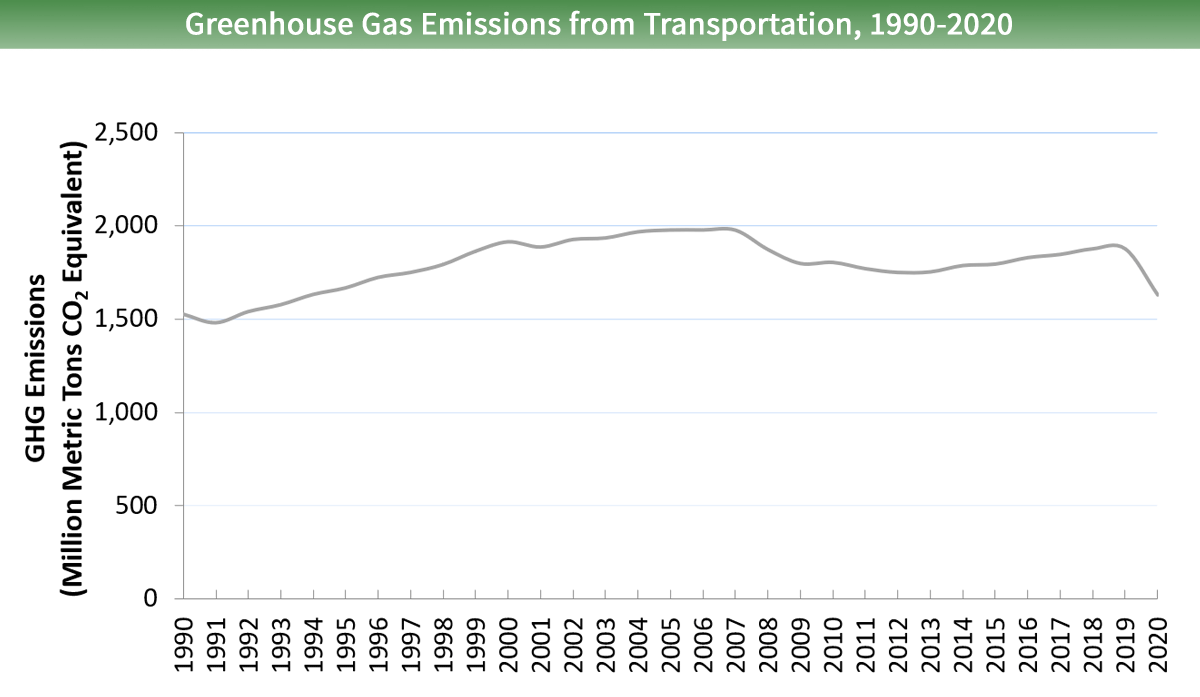
In 2020, greenhouse gas emissions from transportation accounted for about 27% of full U.S. greenhouse gas emissions, making information technology the largest contributor of U.S. greenhouse gas emissions. From 2019 to 2020, transportation sector GHG emissions decreased 13%, primarily a result of the COVID-19 pandemic and associated restrictions that led to less travel. During this period, GHG emissions from passenger transportation decreased by sixteen%, while GHG emissions from domestic freight transportation saw a 6% subtract. In terms of the overall trend, from 1990 to 2020, total transportation emissions take increased due, in large part, to increased demand for travel. The number of vehicle miles traveled (VMT) by light-duty motor vehicles (rider cars and light-duty trucks) increased by thirty% from 1990 to 2020, as a result of a confluence of factors including population growth, economic growth, urban sprawl, and periods of depression fuel prices. Between 1990 and 2004, average fuel economy among new vehicles sold annually declined, as sales of light-duty trucks increased. Starting in 2005, average new vehicle fuel economic system began to increment, while lite-duty VMT grew only modestly for much of the menses. Average new vehicle fuel economy has improved most every twelvemonth since 2005, slowing the rate of increase of CO2 emissions. The light-duty truck share is near 56% of new vehicles in model year 2020.
Acquire more than near Greenhouse Gas Emissions from Transportation.
Larger paradigm to save or print
Reducing Emissions from Transportation
There are a variety of opportunities to reduce greenhouse gas emissions associated with transportation. The table shown below categorizes these opportunities and provides examples. For a more comprehensive list, see Chapter eight of the Contribution of Working Group III to the Fifth Assessment Study of the Intergovernmental Panel on Climate Change.1
| Type | How Emissions Are Reduced | Examples |
|---|---|---|
| Fuel Switching | Using fuels that emit less COtwo than fuels currently being used. Alternative sources can include biofuels; hydrogen; electricity from renewable sources, such as wind and solar; or fossil fuels that are less CO2-intensive than the fuels that they replace. Learn more about Green Vehicles and Alternative and Renewable Fuels. |
|
| Improving Fuel Efficiency with Advanced Design, Materials, and Technologies | Using advanced technologies, design, and materials to develop more fuel-efficient vehicles. Learn about EPA'south vehicle greenhouse gas rules. |
|
| Improving Operating Practices | Adopting practices that minimize fuel use. Improving driving practices and vehicle maintenance. Learn about how the freight transportation industry can reduce emissions through EPA'south SmartWay Programme. |
|
| Reducing Travel Demand | Employing urban planning to reduce the number of miles that people drive each twenty-four hours. Reducing the need for driving through travel efficiency measures such as driver, biking, and pedestrian programs. Learn virtually EPA's Smart Growth Program. |
|
References
- IPCC (2014). Climate change 2014: Mitigation of Climate Change (PDF) (1454 pp, 50 MB). Contribution of Working Group III to the Fifth Assessment Report of the Intergovernmental Panel on Climate change [Edenhofer, O., R. Pichs-Madruga, Y. Sokona, East. Farahani, South. Kadner, K. Seyboth, A. Adler, I. Baum, S. Brunner, P. Eickemeier, B. Kriemann, J. Savolainen, S. Schlömer, C. von Stechow, T. Zwickel and J.C. Minx (eds.)]. Cambridge University Press, Cambridge, United Kingdom and New York, NY, U.s.a..
Industry Sector Emissions
* State Employ, Land-Use Change, and Forestry in the United States is a net sink and removes approximately xiii% of these greenhouse gas emissions. This net sink is not shown in the above diagram. All emission estimates from the Inventory of U.S. Greenhouse Gas Emissions and Sinks: 1990–2020.
Larger image to salvage or impress
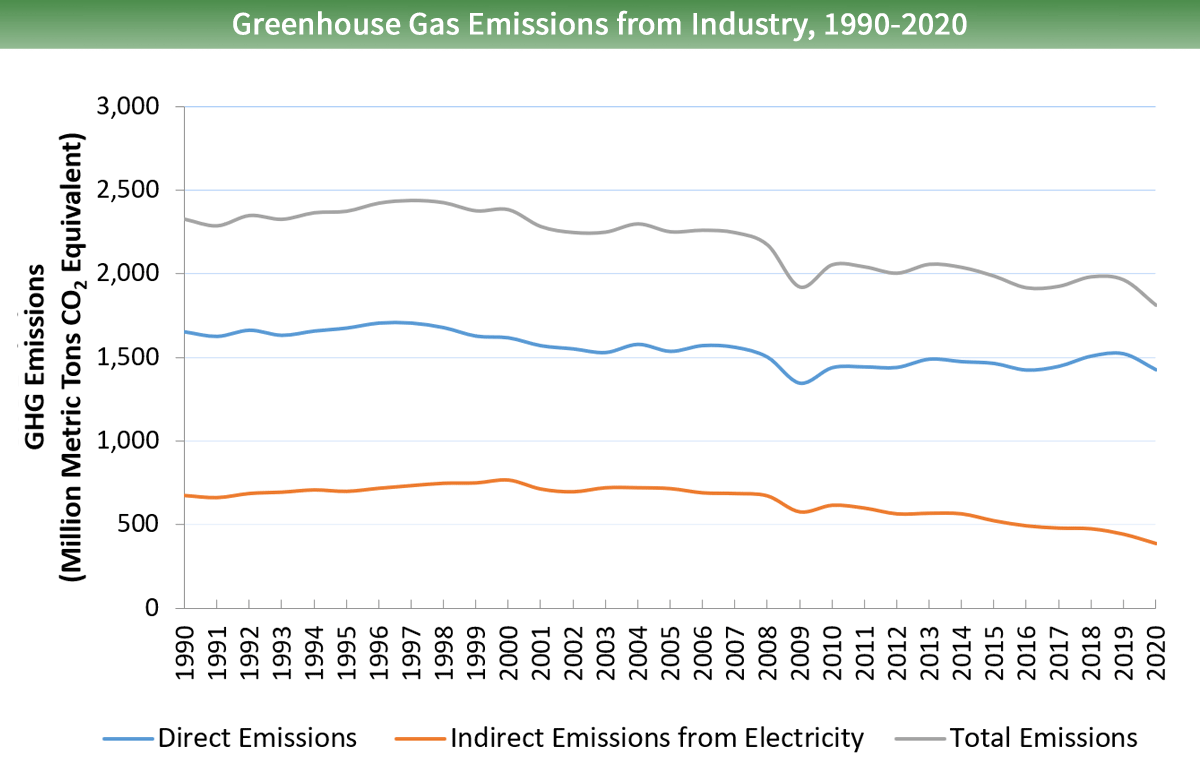
The Industry sector produces the appurtenances and raw materials we use every day. The greenhouse gases emitted during industrial production are split into two categories: direct emissions that are produced at the facility, and indirect emissions that occur off site but are associated with the facility's utilise of electricity.
Directly emissions are produced by burning fuel for ability or heat, through chemic reactions, and from leaks from industrial processes or equipment. Most direct emissions come up from the consumption of fossil fuels for free energy. A smaller amount of direct emissions, roughly one third, come from leaks from natural gas and petroleum systems, the use of fuels in production (e.thou., petroleum products used to brand plastics), and chemic reactions during the production of chemicals, metals (east.g., iron and steel), and minerals (e.g., cement).
Indirect emissions are produced by burning fossil fuel at a ability plant to make electricity, which is and so used past an industrial facility to ability industrial buildings and machinery.
More than information about facility-level emissions from big industrial sources is available through EPA's Greenhouse Gas Reporting Program's data publication tool. National-level data near emissions from industry every bit a whole can be institute in the sections on Fossil Fuel Combustion and the Industrial Processes chapter in the Inventory of U.Due south. Greenhouse Gas Emissions and Sinks.
Emissions and Trends
In 2020, straight industrial greenhouse gas emissions accounted for 24% of total U.S. greenhouse gas emissions, making it the 3rd largest correspondent to U.South. greenhouse gas emissions, after the Transportation and Electricity sectors. From 2019 to 2020, full free energy use in the industrial sector decreased by 5% partially as a consequence of reductions in economic and manufacturing activity due to the COVID-xix pandemic. Including both direct emissions and indirect emissions associated with electricity apply, industry'due south share of total U.S. greenhouse gas emissions in 2020 was 30%, making it the largest contributor of greenhouse gases of any sector. Full U.S. greenhouse gas emissions from industry, including electricity, have declined by 22% since 1990.
Larger paradigm to salvage or print
Reducing Emissions from Industry
At that place are a wide diverseness of industrial activities that cause greenhouse gas emissions, and many opportunities to reduce them. The table shown below provides some examples of opportunities for industry to reduce emissions. For a more comprehensive list, run across Affiliate 10 of the Contribution of Working Group III to the Fifth Assessment Report of the Intergovernmental Panel on Climate change. one
| Blazon | How Emissions Are Reduced | Examples |
|---|---|---|
| Free energy Efficiency | Upgrading to more efficient industrial technology. EPA's Energy STAR® program helps industries go more free energy-efficient. | Identifying ways that manufacturers tin can use less energy to light and heat factories or to run equipment. |
| Fuel Switching | Switching to fuels that result in less COtwo emissions merely the same amount of energy, when combusted. | Using natural gas instead of coal to run machinery. |
| Recycling | Producing industrial products from materials that are recycled or renewable, rather than producing new products from raw materials. | Using scrap steel and scrap aluminum as opposed to smelting new aluminum or forging new steel. |
| Training and Awareness | Making companies and workers enlightened of the steps to reduce or forbid emissions leaks from equipment. EPA has a variety of voluntary programs that provide resources for training and other steps for reducing emissions. EPA supports programs for the aluminum, semiconductor, and magnesium industries. | Instituting handling policies and procedures for perfluorocarbons (PFCs), hydrofluorocarbons (HFCs), and sulfur hexafluoride (SF6) that reduce occurrences of adventitious releases and leaks from containers and equipment. |
References
- IPCC (2014). Climatic change 2014: Mitigation of Climate change (PDF) (1454 pp, l MB). Contribution of Working Group 3 to the Fifth Assessment Study of the Intergovernmental Panel on Climatic change [Edenhofer, O., R. Pichs-Madruga, Y. Sokona, Due east. Farahani, South. Kadner, K. Seyboth, A. Adler, I. Baum, S. Brunner, P. Eickemeier, B. Kriemann, J. Savolainen, S. Schlömer, C. von Stechow, T. Zwickel and J.C. Minx (eds.)]. Cambridge University Printing, Cambridge, United Kingdom and New York, NY, USA.
Commercial and Residential Sector Emissions
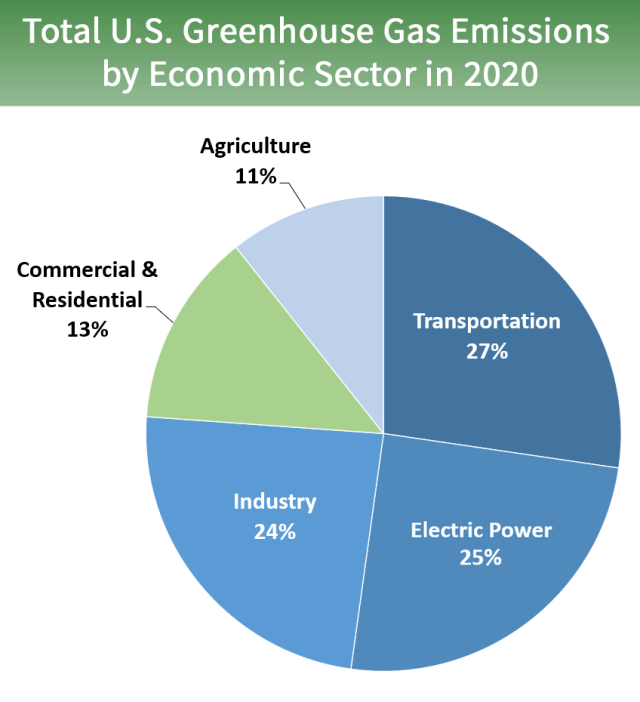
* Land Employ, Land-Use Alter, and Forestry in the United States is a cyberspace sink and removes approximately 13% of these greenhouse gas emissions. This net sink is not shown in the above diagram. All emission estimates from the Inventory of U.S. Greenhouse Gas Emissions and Sinks: 1990–2020.
Larger image to save or print
The residential and commercial sectors include all homes and commercial businesses (excluding agricultural and industrial activities). Greenhouse gas emissions from this sector come from direct emissions including fossil fuel combustion for heating and cooking needs, direction of waste and wastewater, and leaks from refrigerants in homes and businesses as well every bit indirect emissions that occur offsite only are associated with use of electricity consumed past homes and businesses.
Direct emissions are produced from residential and commercial activities in a variety of ways:
- Combustion of natural gas and petroleum products for heating and cooking needs emits carbon dioxide (COtwo), methane (CH4), and nitrous oxide (N2O). Emissions from natural gas consumption represent 79% of the direct fossil fuel CO2 emissions from the residential and commercial sectors in 2020. Coal consumption is a pocket-size component of energy use in both of these sectors.
- Organic waste sent to landfills emits CH4.
- Wastewater treatment plants emit CH4 and NiiO.
- Anaerobic digestion at biogas facilities emits CH4.
- Fluorinated gases (mainly hydrofluorocarbons, or HFCs) used in air conditioning and refrigeration systems tin be released during servicing or from leaking equipment.
Indirect emissions are produced by burning fossil fuel at a power plant to make electricity, which is then used in residential and commercial activities such every bit lighting and for appliances.
More national-level information about emissions from the residential and commercial sectors can be found in the U.Southward. Inventory's Energy and Trends chapters.
Emissions and Trends
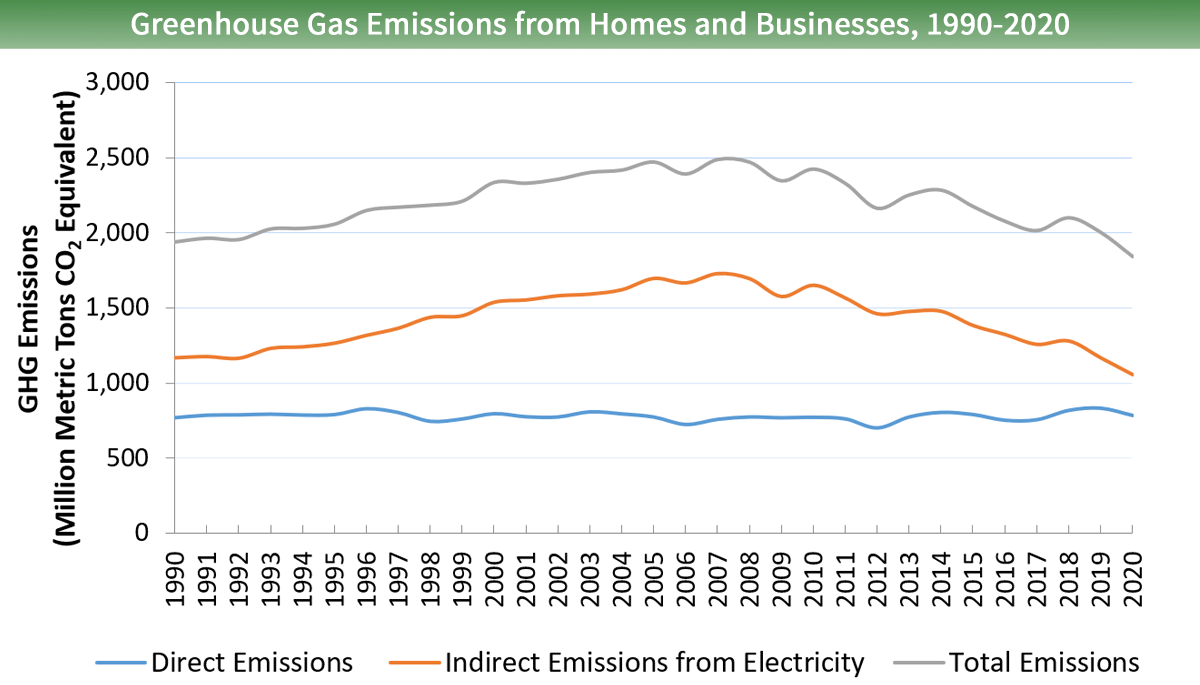
In 2020, directly greenhouse gas emissions from homes and businesses accounted for 13% of total U.South. greenhouse gas emissions. Greenhouse gas emissions from homes and businesses vary from year to yr often correlated with seasonal fluctuations in energy apply caused primarily past atmospheric condition conditions. Full residential and commercial greenhouse gas emissions, including direct and indirect emissions, in 2020 have decreased by five% since 1990. Greenhouse gas emissions from on-site direct emissions in homes and businesses take increased by 2% since 1990. Additionally, indirect emissions from electricity use past homes and businesses increased from 1990 to 2007, but have decreased since so to approximately 10% below 1990 levels in 2020.
Larger image to salvage or print
Reducing Emissions from Homes and Businesses
The table shown below provides examples of opportunities to reduce emissions from homes and businesses. For a more comprehensive list of options and a detailed assessment of how each option affects dissimilar gases, come across Chapter ix and Chapter 12 of the Contribution of Working Group III to the 5th Assessment Report of the Intergovernmental Console on Climatic change.
| Blazon | How Emissions Are Reduced | Examples |
|---|---|---|
| Homes and Commercial Buildings | Reducing energy use through energy efficiency. | Homes and commercial buildings employ large amounts of energy for heating, cooling, lighting, and other functions. "Light-green building" techniques and retrofits can permit new and existing buildings to use less energy to accomplish the aforementioned functions, leading to fewer greenhouse gas emissions. Techniques to ameliorate edifice free energy efficiency include better insulation; more free energy-efficient heating, cooling, ventilation, and refrigeration systems; efficient fluorescent lighting; passive heating and lighting to have advantage of sunlight; and the purchase of free energy-efficient appliances and electronics. Learn more about Energy STAR®. |
| Wastewater Treatment | Making h2o and wastewater systems more than energy-efficient. | Drinking h2o and wastewater systems account for approximately 2% of energy utilisation in the United states. By incorporating energy efficiency practices into their water and wastewater plant, municipalities and utilities can save xv to xxx% in free energy employ. Learn more about Free energy Efficiency for Water and Wastewater Utilities. |
| Waste material Management | Reducing solid waste sent to landfills. Capturing and using marsh gas produced in current landfills. | When solid waste material decomposes in landfills, information technology creates landfill gas, which is primarily comprised of COtwo and CH4. At that place are a number of well established, low-cost methods to reduce greenhouse gases from consumer waste material, including recycling programs, waste reduction programs, and landfill methyl hydride capture programs.
|
| Air Conditioning and Refrigeration | Reducing leakage from air conditioning and refrigeration equipment. Using refrigerants with lower global warming potentials. | Commonly used refrigerants in homes and businesses include ozone-depleting hydrochlorofluorocarbon (HCFC) refrigerants, often HCFC-22 and blends consisting entirely or primarily of hydrofluorocarbons (HFCs), both of which are strong greenhouse gases. In recent years there have been several advancements in air conditioning and refrigeration engineering science that tin can help homes and businesses reduce both refrigerant charges and refrigerant emissions. For example, in the retail nutrient sector, learn more most EPA's GreenChill Program to reduce greenhouse gas emissions from supermarkets. |
Agriculture Sector Emissions
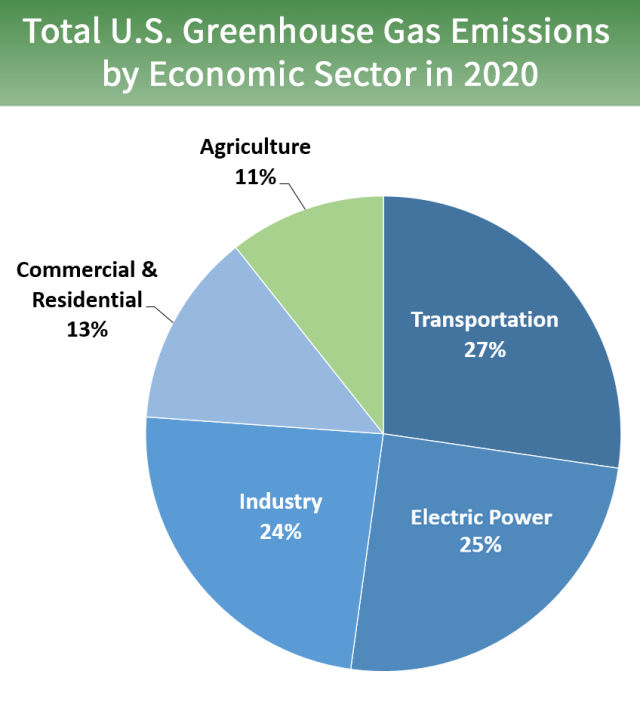
* State Apply, Land-Employ Change, and Forestry in the United States is a net sink and removes approximately 13% of these greenhouse gas emissions. This internet sink is non shown in the above diagram. All emission estimates from the Inventory of U.Due south. Greenhouse Gas Emissions and Sinks: 1990–2020.
Larger image to save or print
Agricultural activities — crop and livestock production for food — contribute to emissions in a multifariousness of ways:
- Various management practices on agricultural soils can atomic number 82 to increased availability of nitrogen in the soil and result in emissions of nitrous oxide (N2O). Specific activities that contribute to N2O emissions from agricultural lands include the application of synthetic and organic fertilizers, the growth of nitrogen-fixing crops, the drainage of organic soils, and irrigation practices. Management of agricultural soils accounts for only over half of the greenhouse gas emissions from the Agronomics economical sector.*
- Livestock, especially ruminants such as cattle, produce methane (CHfour) every bit part of their normal digestive processes. This procedure is called enteric fermentation, and it represents over a quarter of the emissions from the Agronomics economical sector.
- The fashion in which manure from livestock is managed also contributes to CH4 and Northward2O emissions. Different manure treatment and storage methods impact how much of these greenhouse gases are produced. Manure management accounts for about 12% of the total greenhouse gas emissions from the Agriculture economic sector in the United states of america.
- Smaller sources of agricultural emissions include CO2 from liming and urea application, CH4 from rice cultivation, and burning ingather residues, which produces CH4 and Due north2O.
More data about emissions from agriculture can exist institute in the agriculture chapter in the Inventory of U.S. Greenhouse Gas Emissions and Sinks.
* Management of croplands and grasslands can also lead to emissions or sequestration of carbon dioxide (CO2). These emissions and removals are included under the Land Use, Country-Utilize Alter, and Forestry sector.
Emissions and Trends
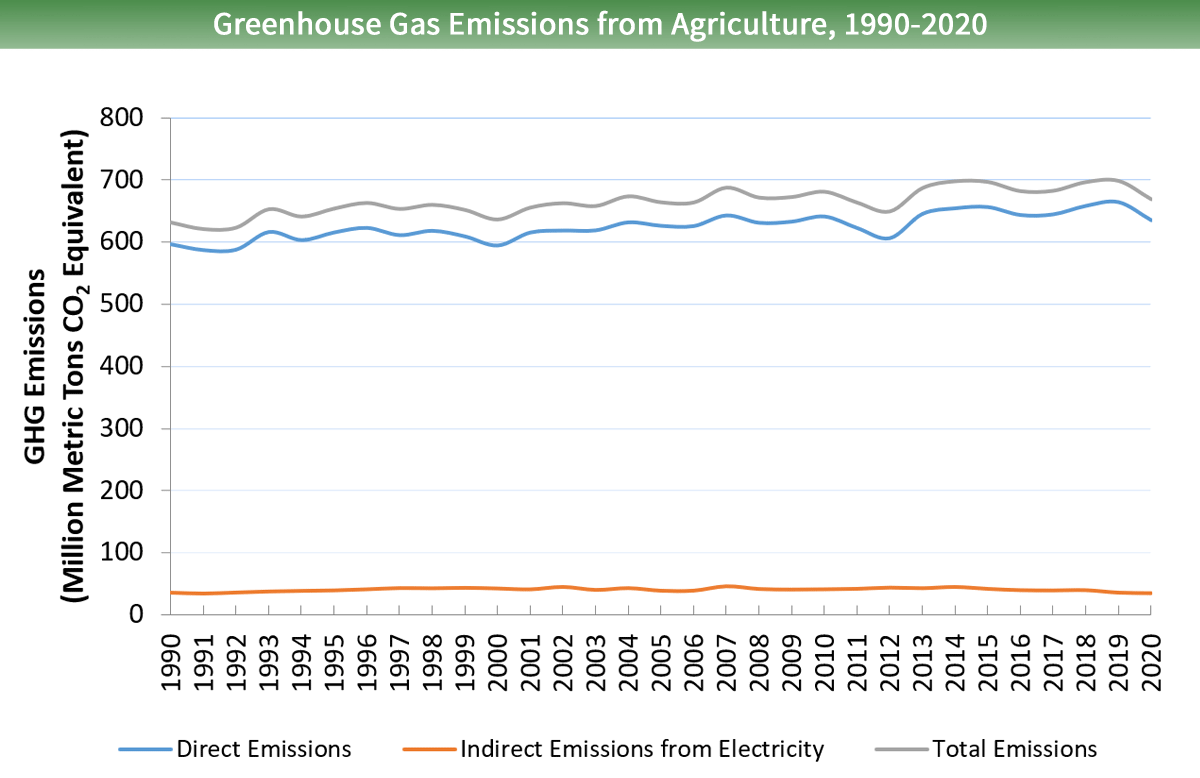
In 2020, greenhouse gas emissions from the agriculture economical sector deemed for eleven% of total U.S. greenhouse gas emissions. Greenhouse gas emissions from agriculture have increased by 6% since 1990. This increment is largely driven by a 62% growth in combined CHfour and N2O emissions from livestock manure management systems, reflecting the increased apply of emission-intensive liquid systems over this time catamenia. Emissions from other agricultural sources have generally remained apartment or inverse by a relatively minor amount since 1990.
Larger paradigm to save or print
Reducing Emissions from Agriculture
The table shown below provides examples of opportunities to reduce emissions from agriculture. For a more comprehensive list of options and a detailed assessment of how each selection affects different gases, see Chapter eleven of the Contribution of Working Group Three to the 5th Assessment Report of the Intergovernmental Panel on Climate change.
| Type | How Emissions Are Reduced | Examples |
|---|---|---|
| Land and Crop Management | Adjusting the methods for managing land and growing crops. |
|
| Livestock Management | Adjusting feeding practices and other management methods to reduce the amount of methane resulting from enteric fermentation. |
|
| Manure Management |
|
|
Country Use, Land-Use Change, and Forestry Sector Emissions and Sequestration
Plants absorb carbon dioxide (COtwo) from the atmosphere as they grow, and they shop some of this carbon equally aboveground and belowground biomass throughout their lifetime. Soils and dead organic thing/litter can besides store some of the carbon from these plants depending on how the soil is managed and other environmental conditions (e.g., climate). This storage of carbon in plants, dead organic thing/litter and soils is called biological carbon sequestration. Because biological sequestration takes COtwo out of the atmosphere and stores it in these carbon pools, information technology is also chosen a carbon "sink."
Emissions or sequestration of COtwo, as well every bit emissions of CH4 and NtwoO can occur from management of lands in their current apply or as lands are converted to other land uses. Carbon dioxide is exchanged between the atmosphere and the plants and soils on land, for instance, as cropland is converted into grassland, as lands are cultivated for crops, or every bit forests abound. In improver, using biological feedstocks (such equally energy crops or forest) for purposes such as electricity generation, as inputs to processes that create liquid fuels, or as edifice materials tin can atomic number 82 to emissions or sequestration.*
In the Us overall, Land Utilize, State-Utilize Modify, and Forestry (LULUCF) activities have resulted in more than removal of CO2 from the temper than emissions. Considering of this, the LULUCF sector in the United States is considered a net sink, rather than a source, of CO2. In many areas of the globe, the opposite is true, peculiarly in countries where big areas of forest state are cleared, often for conversion to agronomical purposes or for settlements. In these situations, the LULUCF sector can be a net source of greenhouse gas emissions.
- More than national-level information nigh country employ, land-utilize change, and forestry is bachelor from the State Apply, State-Employ Alter, and Forestry affiliate in the Inventory of U.Southward. Greenhouse Gas Emissions and Sinks. For more than information on emissions and sequestration from woods country and urban copse in settlement areas, see likewise the USFS Resource Update.
- For more information about global emissions from land apply and forestry activities, see EPA'south Global Greenhouse Gas emissions page and the Contribution of Working Group 3 to the Fifth Assessment Report of the Intergovernmental Panel on Climate change.
* Emissions and sequestration of CO2 are presented under the Land Use, Land-Use Change, and Forestry sector in the Inventory. Emissions of marsh gas (CH4) and nitrous oxide (N2O) also occur as a issue of land use and management activities in the LULUCF sector. Other emissions from CH4 and Northward2O are also presented in the Free energy sector.
Emissions and Trends
In 2020, the net COtwo removed from the atmosphere from the LULUCF sector was 14% of total U.South. greenhouse gas emissions. Between 1990 and 2020, total carbon sequestration in the LULUCF sector decreased by 9%, primarily due to a subtract in the rate of cyberspace carbon accumulation in forests, every bit well equally an increase in COii emissions from urbanization. Additionally, while episodic in nature, increased CO2, CHfour and NorthtwoO emissions from forest fires have also occurred over the time series.
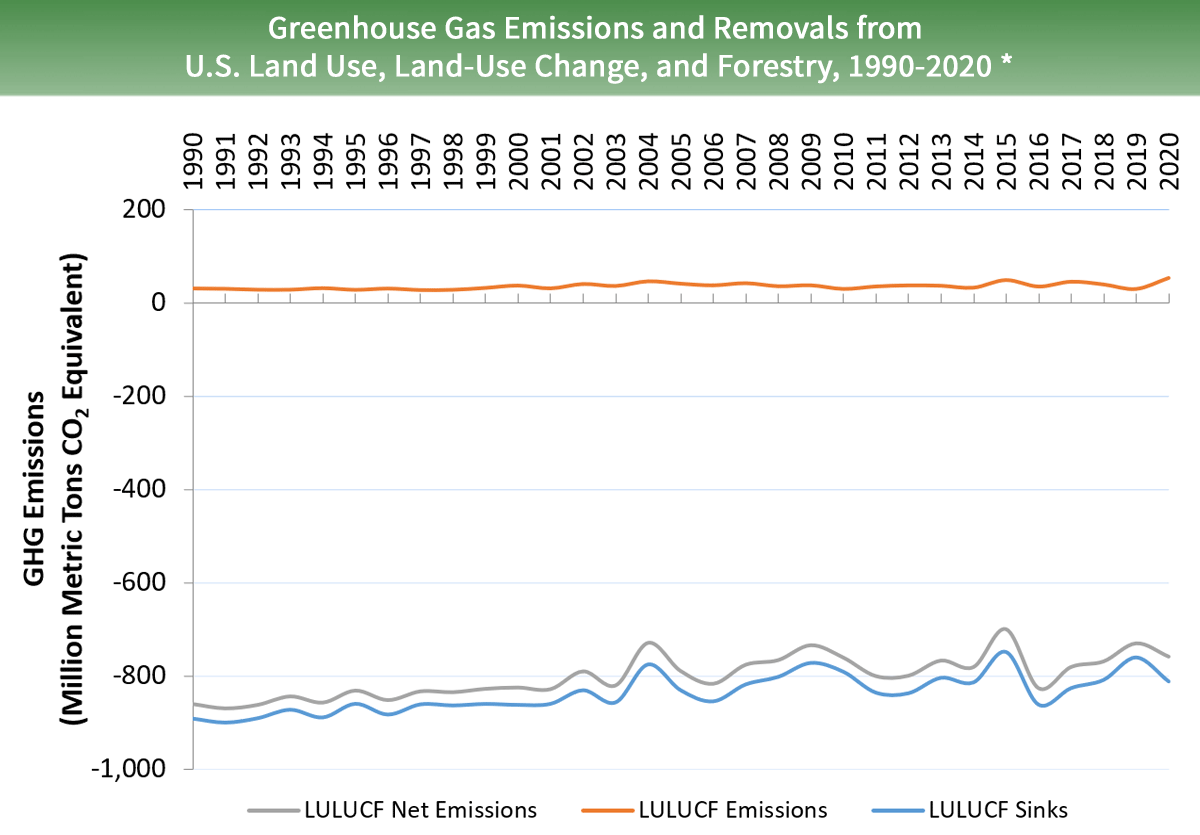
Larger image to save or print
Reducing Emissions and Enhancing Sinks from Land Use, Land-Use Change, and Forestry
In the LULUCF sector, opportunities exist to reduce emissions and increase the potential to sequester carbon from the atmosphere by enhancing sinks. The table shown below provides some examples of opportunities for both reducing emissions and enhancing sinks. For a more comprehensive listing, see Chapter xi of the Contribution of Working Group 3 to the Fifth Cess Study of the Intergovernmental Console on Climate change.
| Type | How Emissions Are Reduced or Sinks Are Enhanced | Examples |
|---|---|---|
| Change in Uses of Land | Increasing carbon storage by using state differently or maintaining carbon storage by avoiding land deposition. |
|
| Changes in Land Management Practices | Improving direction practices on existing land-use types. |
|
Source: https://www.epa.gov/ghgemissions/sources-greenhouse-gas-emissions
0 Response to "Beef Are the Leading Source of Methane Production"
Post a Comment